Pages

Showing posts with label Clinical Microbiology. Show all posts

Tuesday, April 21, 2015

BASIC LABORATORY PROCEDURES IN CLINICAL BACTERIOLOGY

Communicable diseases are the most common cause of death in developing
countries, and their diagnosis and treatment represent a significant challenge
to the health services in those areas. The World Health Organization has long
been actively involved in developing and promoting standard techniques for
laboratory investigations of such diseases, a first attempt to standardize susceptibility
testing of bacterial pathogens being made in 1960.1 Following on
from this, in 1976, the WHO Expert Committee on Biological Standardization
drew up requirements for antibiotic susceptibility testing using the disc
method.2
At the same time, efforts were being made to introduce quality control into
laboratory performance. In 1981, WHO established an International External
Quality Assessment Scheme for Microbiology. The laboratories that are
involved in this scheme are able to play a leading role in the implementation
of national quality assessment schemes at all levels of the health care system.
The present publication brings together and updates the various guidelines
produced by WHO over the years on sampling of specimens for laboratory
investigation, identification of bacteria, and testing of antimicrobial resistance.
The information included is intended to lead to harmonization of microbiological
investigations and susceptibility testing, and to improve the quality of
laboratories at both central and intermediate levels. It concentrates on the procedures
to be followed, rather than the basic techniques of microscopy and
staining, which have been described in detail in another WHO publication.3

Monday, April 20, 2015

Other Microbiology / Parasitology

Microbial pathogens include microscopic organisms such as bacteria, viruses, and
protozoans, as well as multicellular organisms such as helminths (worms) and other
parasites. Accurate microbial identification is critical for the optimal treatment of
patients presenting with infection. Laboratory tests are often essential for guiding
effective intervention. A wide range of testing options for infectious disease pathogens
is available and varies by organism. These include in vitro detection of an antibody or
antigen (serology), culture-based methods, and molecular assays that detect microbial
DNA or RNA. The types of organisms likely to cause infection can vary significantly with
geography. This section will address more prevalent microbial and parasitic infections.

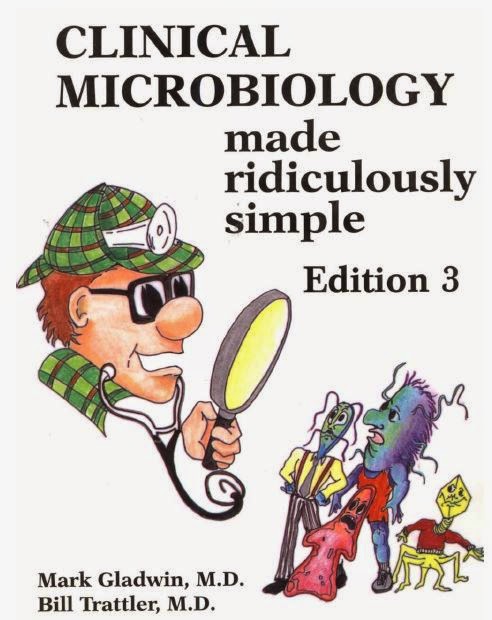
Clinical Microbiology Made Ridiculously Simple 3rd Edition

A well-developed knowledge of clinical microbiology is
critical for the practicing physician in any medical field.
Bacteria, viruses, and protozoans have no respect for
the distinction between ophthalmology, pediatrics,
trauma surgery, or geriatric medicine. As a physician
you will be faced daily with the concepts of microbial
disease and antimicrobial therapy. Microbiology is one
of the few courses where much of the "minutia" is regularly
used by the practicing physician.
This book attempts to facilitate the learning of microbiology
by presenting the information in a clear and
entertaining manner brimming with memory aids.
Our approach has been to:
1) Write in a conversational style for rapid assimilation.
2) Include numerous figures serving as "visual memory
tools" and summary charts at the end of each chapter.
These can be used for "cram sessions" after the
concepts have been studied in the text.
3) Concentrate more on clinical and infectious disease
issues that are both interesting and vital to the actual
practice of medicine.
Preface
D
4) Create a conceptual, organized approach to the organisms
studied so the student relies less on memory
and more on logical pathophysiology.
The text has been updated to include current information
on rapidly developing topics, such as HIV and
AIDS (vaccine efforts and all the new anti-HIV medications),
Ebola virus, Hantavirus, E. coli outbreaks, Mad
Cow Disease, and brand-new antimicrobial antibiotics.
The mnemonics and cartoons in this book do not intend
disrespect for any particular patient population or
racial or ethnic group but are solely presented as memory
devices to assist in the learning of a complex and important
medical subject.
We welcome suggestions for future editions.
MARK GLADWIN, MD
BILL TRATTLER, MD